A good content strategy starts with research. Keyword research is a great starting point for any brand that’s not sure where to start with SEO or is looking to re-evaluate their current plan. Promodo‘s infographic outlines key components of keyword research in a five-step process.
Take notes, because this step in your planning process should not go ignored. It gives you a good look into the behavior of your buyer personas, their preferences, how you should tailor your content to encourage return visits, and how you can utilize SEO to gain higher visibility in search engines.
SEO errors on e-commerce websites can cost you money and this alone is a very good reason for spending time and effort to get SEO right.
Unlike blogs and content rich websites (e.g. fitness sites), on-line shops are more difficult to configure for SEO especially if the products you are selling are available in more than one websites. What I will explain below are the 5 critical SEO Errors that e-commerce websites make and how you can avoid them.
This is the first post in a series of articles about ‘SEO for e-Commerce Websites” where I will provide you with some real examples and case studies on how to SEO your e-commerce website for maximum visibility in the SERPS. You can use this link to subscribe to my newsletter and receive all updates in your inbox.
#1 – Product titles are not unique or SEO optimized
Product titles are very important for on-page SEO. I did explain in the pastwhy titles have to be optimized and from my experience with e-commerce websites, this is still the number 1 mistake that most webmasters do.
Titles that are duplicated either within the same website or in other websites is one of the reasons why your ecommerce website is not performing well in search.
What are the characteristics of a good product title?
Less than 70 characters
Unique within the website – no other product in the store has the same title
Be indicative on what the product is about
Talk the user’s language – The product title should include keywords or phrases that people use to search for the particular product and not the technical name of a product.
Some tips of writing good product titles
I know that it’s difficult to come up with unique product titles when you have a lot of similar products. Once you write the titles of a couple of products, you run out of ideas and inevitably the rest of the titles are duplicated.
What you can do is to include product attributes and characteristics in the title (colors, size, material, etc) as well as the brand/model name where applicable. For example let’s say you are selling tablets, here are a few unique titles that you can use for similar products.
“Samsung Android Tablet”
“16GB Samsung Android Tablet”
“16GB White Samsung Android Tablet”
“16GB/3G Samsung Tablet running Android”
#2 – Lack or duplicate product descriptions
Besides the title another important part of ecommerce SEO is the product description. A critical SEO error that most websites do is either having no product descriptions or if they have is the same content you can find on hundreds of other websites on the web.
Let me explain very quickly why this is bad. Imagine that you are selling a product that is also found on Amazon, eBay and other popular and well-known websites. In your product description you have the exact content that is already on Amazon.
When search engines come to crawl your website they will understand that the content you have is already in their index so they will just ignore it and move on. If they find that many of your pages follow the same pattern, they will ignore your website as a whole.
On the other hand, if while they crawl your website they find original content about the products you are selling, they will include the content in their index and this is the first successful step in your effort to achieve better rankings for your ecommerce store.
A note about lack of content. We always say that we need to ‘fetch the search engines with content’ and the real reason why we should do that is because content helps them understand what the page is all about. If in your product pages you only have images of the product and a title that does not give them enough information so as to analyse and decide what to do with the particular page.
How do you write good product descriptions?
As with the titles, it is difficult to write product descriptions that are unique for each product and that’s why you need to think hard what to write about. A good tip is to try and describe in words the product by highlighting the physical differences with other similar products. For example imagine you are selling different colours of pens (same model), here are a few descriptions:
“A stylish ball pen with a white label. The main body comes with a brown finish that is both elegant and ….”
“A blue ball pen suitable for left handers. Your logo is printed with white letters on the top part of the pen and…”
#3 – Bad formatted URLS
It is common for many shopping engines to present the product pages with URLS like: http://www.myshop.com/productid12?EEFEFS4 which are unreadable for both search engines and users. Most of them are like that because when those systems were developed, it was easier for the programmers to build the URLS using that pattern, of course without taking SEO into account.
If you are lucky, the platform you are using will allow you to change the url to something more meaningful, for example http://www.myshop.com/16-gb-samsung-tablet-white.
Note: When doing so, don’t forget to do 301 redirections from the old to the new URLS
When thinking about your URL structure try to create it based on your product groups or categories. For example if you are selling android-tablets and phones you can have the following category urls:
http://www.myshop.com/android-tablets
http://www.myshop.com/apple-iphones
#4 – Website takes too much time to load
Besides the URLS, product titles and descriptions another important element in selling online is the website speed. There are many studies that show a clear correlation with website speed and product sales i.e. faster websites generate more sales.
If the software you are using is old and out of date or if you cannot optimize the code as you like, then most probably you will end up in the same category as hundreds of online shops that take a long time to load, keeping potential customers away.
As an ecommerce web owner you need to make sure that your shop loads as fast as possible (preferably in less than 4 seconds), both on desktops, tablets and mobiles. In order to achieve that you can:
Optimize your images, videos – Optimization reduces the size of the pages and they load faster
Optimize your code – if you cannot do that, hire a programmer to optimize the code of your shop by avoiding unnecessary code calls that may slow down the website
Optimize your pages – On the product pages keep the items that can help you make sales and not the items you think are useful (this is a huge topic and will cover it in more details in the next articles of the series)
#5 – Lack of usability
All the above SEO errors are related to one thing: usability. True SEO is about usability, user friendliness and user experience and to make sales online, your shop has to be usable. This depends on many factors but in general an online shop should be:
Last but not least, the usability of an online shop has to do with the type of products you are selling. For best results the shop software you are using, should be customised to accommodate and showcase your products in the best possible way.
For example a shop that was designed to sell clothes cannot be used to sell cars. It may be usable for the user looking for clothes but not for the user looking for cars. What I am saying is that it is nice to use one of the out-of-the-box shopping software available on the web but make sure that you can customize it so that it’s usable for the users looking for the products you are selling.
Conclusion
Selling products and services online is what makes the Internet so powerful and useful for all of us. While the idea of selling on the Internet is appealing to many, when it comes to actually doing it, it needs a lot of thought and hard work to create a shop that people will trust and use.
The 5 SEO errors described above are typical errors that many business owners do and that negatively affect the performance of their online business.
Stay tuned for more e-commerce SEO tips and advice.
5 SEO errors of e-commerce websites by Alex Chris
The difference between SEO and SEM is simply that Search Engine Optimization is part of Search engine marketing or Search marketing as it is widely known. Both processes aim in increasing visibility in search engines. SEO is about optimizing the web property to get better rankings in the search results while SEM goes beyond SEO. It involves other methods as well which can get you more search engine visitors like PPC advertising.
Search Engine Optimization (SEO)
I have explained before what is SEO and why is it important and I have also outlined what in my opinion are the most important SEO tips. For the purpose of doing a comparison between SEO and SEM I will re-state the definition of SEO so that it is clear for everybody what the difference between the two is.
What is SEO?
SEO is the process of optimizing your web site for the purpose of getting free traffic from search engines. An optimized web site is more easily understood by Search engine crawlers, so there are more chances of ranking higher in SERPS.
On-Site and Off-site SEO
There are 2 main pillars of SEO, what is called on-site SEO and off-site SEO. On-Site SEO are rules you can apply on your web site or blog so that it’s more search engine friendly. For example you need to use proper titles, good descriptions, well formatted URLs, correct use of H1, H2 and images and many more. You can read my version of the 15 on-site seo tips for beginners to get a good idea of how you can optimize your web site for search engines.
Off-site SEO refers to the process of getting votes from other web sites for the purpose of increasing your web site’s trust in the eyes of search engines. For beginners this may be confusing but try to think about it like a ranking system where the web site who has the most votes ranks higher. Votes in our case are links coming from other web sites to your site. That is also the reason why off-site SEO is referring to as link building.
To avoid any misunderstandings it’s not only a matter of how many links you have pointing to your website but also from where these links are coming and a number of other factors I am not going to cover now.
Search Engine Marketing (SEM)
Search Engine Marketing is over and above SEO but it’s only a subset of your overall Internet Marketing Strategy. The diagram below shows the relationship between Internet Marketing, SEM and SEO. As you can see there are many more ways to increase your web site’s traffic besides SEM and SEO.
What is SEM?
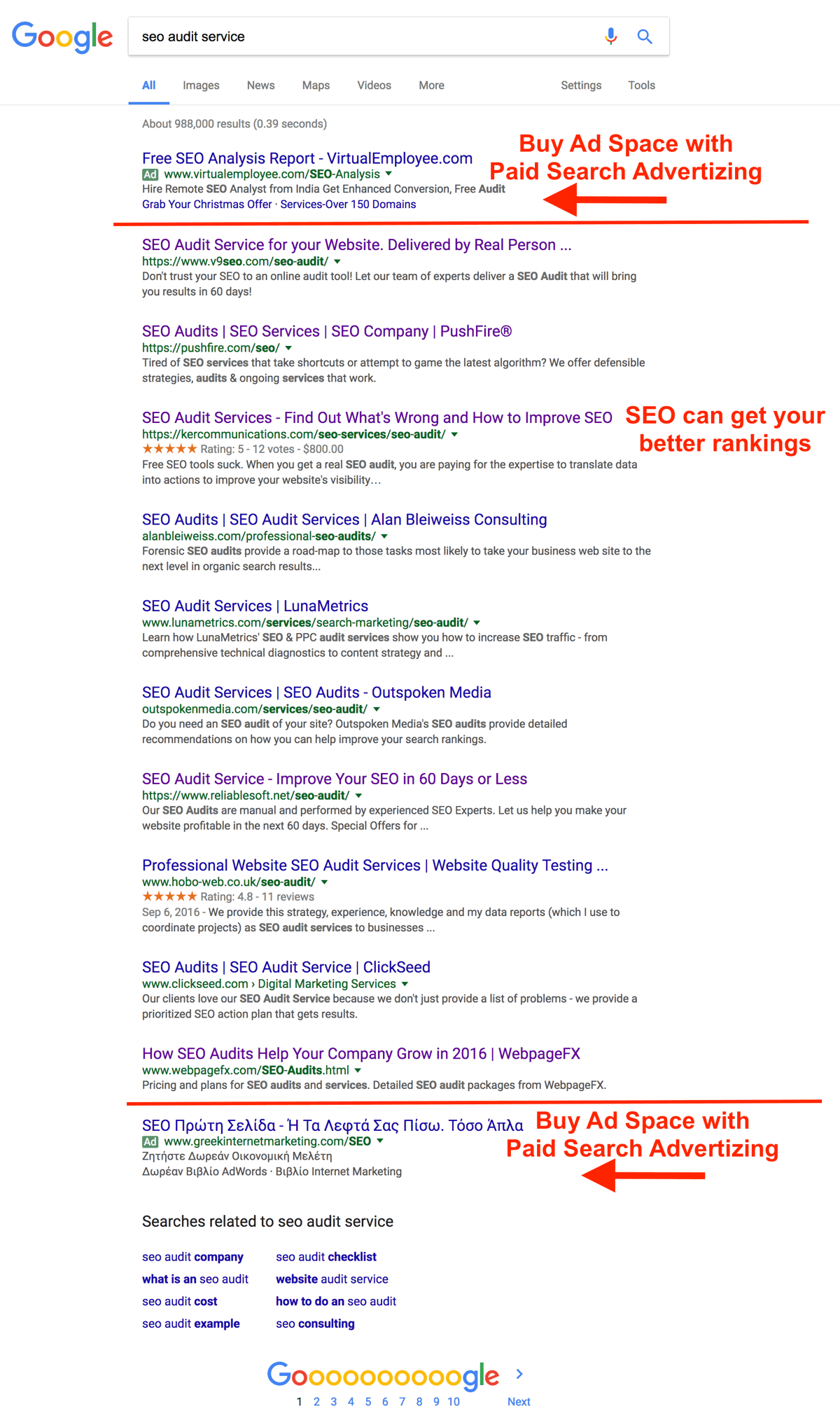
So, SEM is the marketing process with a goal of getting more visibility in search engines either by getting more free traffic (SEO) or paid traffic (Paid search advertising).
Through paid search advertising you essentially buy advertising space in the search engine results. So instead of trying to rank higher and get free traffic you pay to appear in front of the searches.
The most well-known advertising agency for PSA is Google Adwords. Through Google adwords you can get your ads appear in the Google search results and you pay only for the clicks on your ads. This is also the reason why the whole process is called Pay-per-click or PPC. Bing and Yahoo have a similar system but it not so successful and widely known as Adwords.
Importance of SEM Traffic
SEM traffic is considered the most important source of Internet traffic because it is targeted. It is widely accepted that people use the search engines to find a solution to a problem, an answer to their question or to learn how to do something. So when searches click on a web site from the search results or click on an ad, they are more likely to convert. The relevancy of the displayed web sites and ads makes SEM traffic more valuable than any of the other sources. Facebook and twitter are trying to optimize their advertising platforms to utilize targeted traffic but still traffic coming directly from search engines has a better ROI.